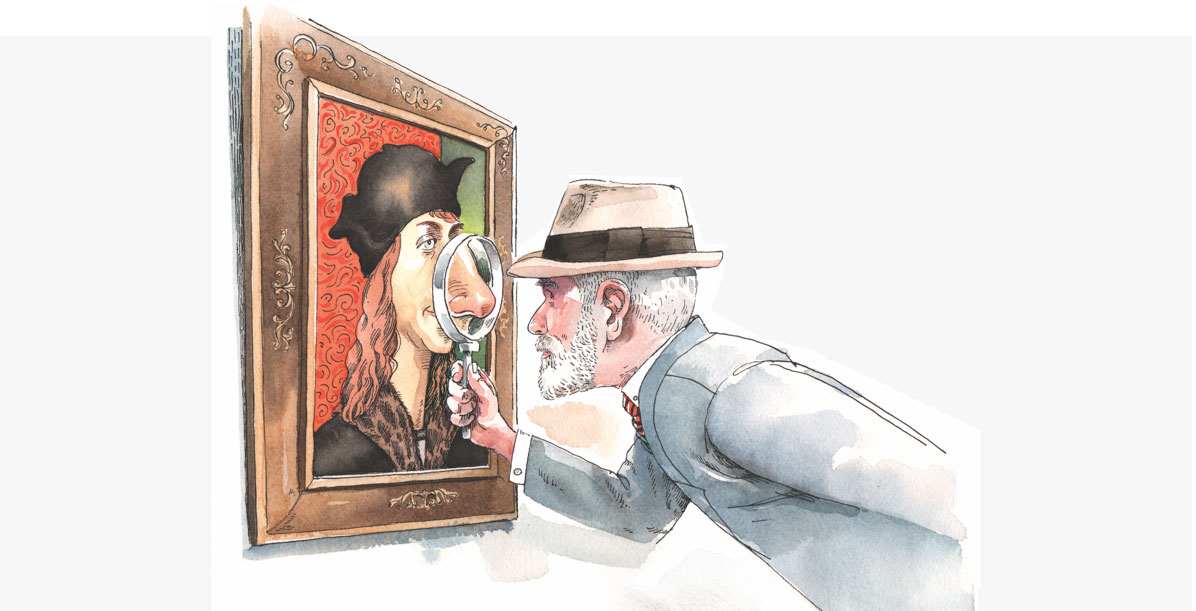
Undoing Reality Through Language
BY SARA LIM
“If thought corrupts language, language
can also corrupt thought.”George Orwell, Politics and the English Language
In the beginning, God spoke the universe into existence, establishing a foundational truth: to command language is to command reality itself. God’s divine act revealed that language can both create and destroy. For mankind, language is not a mere vehicle for communication but the architecture of thought and perception. Language serves as both a gateway and a barrier to truth; it both illuminates reality and distorts our perception of it. Language, therefore, operates simultaneously as an expression and a reflection of our collective human conscience, capturing both moral clarity and decay. The representation of Jews in history and in our current moment demonstrates this phenomenon.
I was recently rifling through my greatgrandfather’s forgotten files, and I found a document from 1938, describing how his brother, Yaakov Isaevich Levin, was “subjected to execution by shooting.” The Soviet document describing his death offers no explanation for his killing—no crime, no trial, no humanity. Just bureaucratic euphemism masking murder. What court or agency ordered his killing? What, if anything, had he done to deserve this fate? These details are lost to history. Instead, I found words deliberately emptied of meaning, designed to conceal rather than explain.
My ancestor’s example is typical of bloodthirsty regimes seeking to cover up their crimes, using coded words to mask the true nature of the horrors they inflict. In official Nazi documents, mass executions are Sonderbehandlung (“special treatment”), deportation is Umsiedlung (“resettlement”), and forced removal is Evakuierung (“evacuation”). These terms sever the connection between perpetrator and victim, between decision and death. Language can be used to render the unthinkable into the simply procedural.
Since its founding, the terrorist organization Hamas has exploited this principle with vile precision. While its original (and never officially repudiated) 1988 charter is violently fanatical, its “sanitized” 2017 charter is its worst rhetorical abuse. The Hamas Document of General Principles and Policies does not contain any explicit antisemitism; its pernicious aims are camouflaged. The document refers to the “Zionist project” as “racist, aggressive, colonial, and expansionist.” By appropriating progressive terminology, an organization fundamentally antithetical to liberal principles cynically positions itself within its framework.
The same manipulation turns Jewish self-determination into oppression, employing the vocabulary of human rights to justify Hamas’ genocidal aims. Where Nazi euphemisms hid atrocity through bureaucratic remoteness, Hamas inverts moral categories entirely: it makes the target “responsible” for their dehumanization. When Jews are not merely enemies but embodiments of systemic evil, their destruction is not murder but liberation. Language ceases to describe reality and begins to alter it. Violence is not only permissible but righteous.
In 1975, Hamas deception achieved institutional sanctification when the UN declared that “Zionism is a form of racism and racial discrimination.” Though later rescinded, the resolution’s reasoning endures. Applying settler-colonialist theory to Zionism erases Jewish indigeneity to Israel while celebrating false universalism. Moreover, it establishes the elimination of Israel as the logical remedy; settler-colonialism, by definition, morally demands the removal of settlers rather than the reform of systems. Indeed, this mirrors the language used in the 2017 Hamas charter:
“There shall be no recognition of the legitimacy of the Zionist entity. Whatever has befallen the land of Palestine in terms of occupation, settlement building, Judaization or changes to its features or falsification of facts is illegitimate.”
The “Zionist entity” is demonized; the only noble response is to pursue “liberation” through “all means necessary.” This linguistic construction establishes the conditions for atrocity.
Furthermore, the weaponization of language against Jews and Israel both condemns Jewish existence and infantilizes Palestinians. Patronizing Western media outlets and academics refuse to take Palestinians’ homicidal declarations or antisemitism at face value. When Hamas officials proclaim their commitment to Israel’s destruction and Palestinian educational materials glorify martyrdom and demonize Jews, Western commentators perform gymnastics to interpret these statements as metaphorical, born of despair, or merely rhetorical. While every Israeli statement is scrutinized for hidden genocidal intent and subjected to the least charitable interpretations, Palestinians’ calls for Zionist annihilation are dismissed as understandable frustration.
This double standard—hypervisibility of imagined Jewish malice, disregard for Palestinian eliminationism—reveals how antisemites can permanently alter discourse not just by slandering Jews, but by ignoring Palestinian discourse and behavior. This willful blindness ultimately undermines the moral clarity necessary for genuine peace.
In recent years, Western public discourse has become its own warzone. Terms like “apartheid,” “genocide,” and “colonialism” permeate conversations, imparting the gravity of existential struggle to every debate. Semantics and memory are distorted by the human aversion to guilt and the desire to absolve oneself from sin. The Shoah becomes the Holocaust (etymologically derived from the Greek word ὁλοκαυτεῖν, or “burnt offering”), and the massacre of October 7th is described as “justified resistance.” This is linguistic anesthesia; dulling truth’s sting, enabling complicity, and facilitating perpetuation. Such willful distortions constitute moral failure. The pattern that began long before my great-great uncle’s murder persists in campus protests and UN resolutions, in academic journals and social media hashtags. The vocabulary evolves, but the function remains the same: using language to transform human beings into abstractions for elimination.
These are not inevitable developments but deliberate choices. Every euphemism, inversion, and redefinition represents a decision to obscure rather than confront. The words change, but their consequences do not. We must not surrender language to those who would wield it against us.
Suggested Reading

Shining Our Light Unto the Nations Through Jewish Teachings
BY ADIN LINDEN Jewish history is rife with enemies, from the Egyptians to the descendants of Amalek, a lineage that is seen as the greatest enemy of the Jews and…
Between Separating Ourselves and Seeing Ourselves in Others
BY YAEL BURGESS EISENBERG When a gentile came before Hillel and said he would convert to Judaism if Hillel could teach him the entire Torah while standing on one foot,…
Fortifying the “Torah” in Torah u-madda: A Plea to Modern Orthodox Day Schools
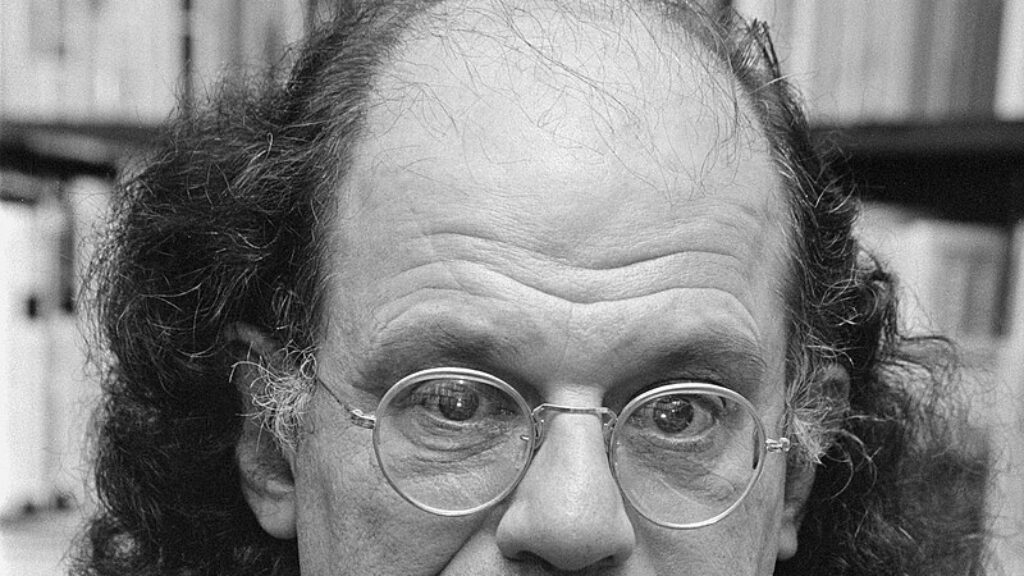
In a deep look at his background and motivations, the picture of Jewish writer Allen Ginsberg becomes more clear to the observer. His difficult past and masterful mix of secular, religious, and kabbalistic, as well as various other, themes in his work came to a head in his poem "Kaddish", written to be an elegy for his mother.

Learning as Creation: The Power of Jewish Education
BY ZACHARY KROHN It is no secret that education is one of the highest values of Judaism, and one can give many reasons for why that is the case. Education…